Category:
AI Transformation
AI Leadership
Published date:
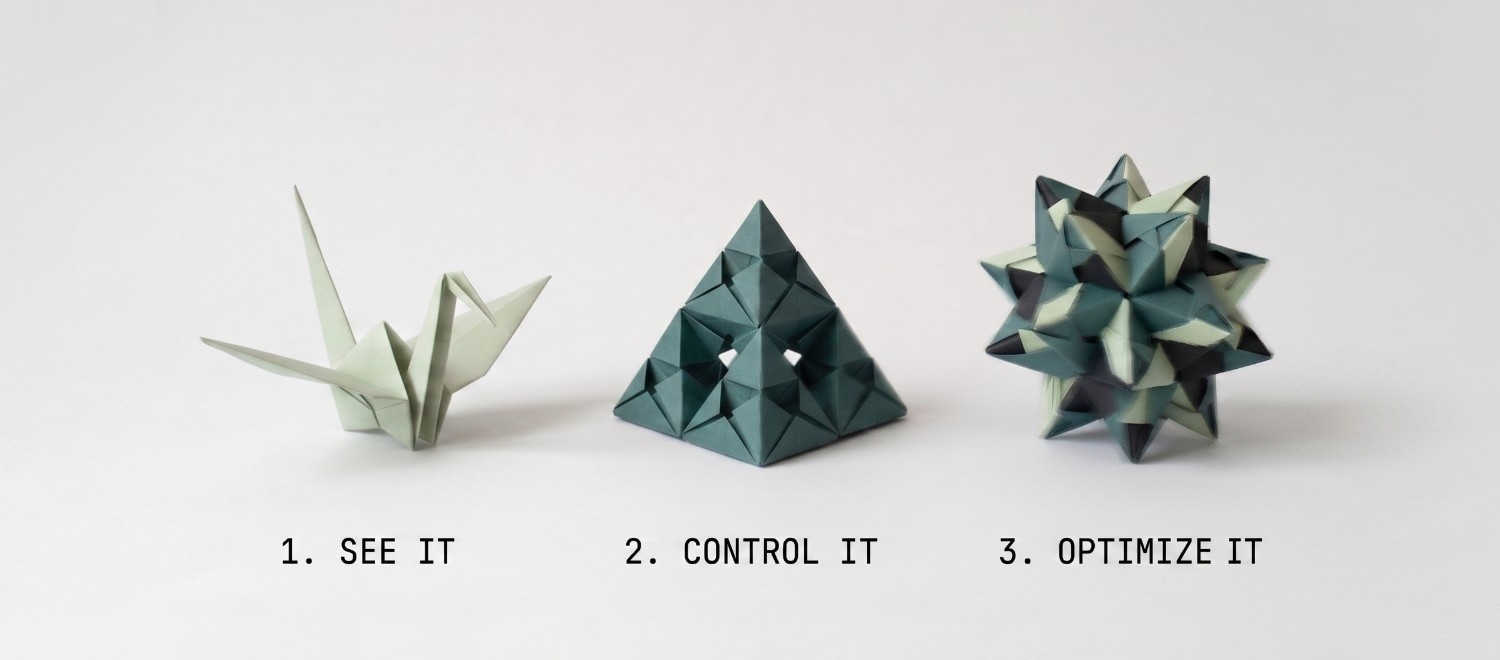
The Three Stages of AI Transformation: See, Control, Optimize
AI transformation is the progression from scattered, unmanaged AI use to a state where every AI dollar and every AI call is visible, governed and tied to a business outcome. It happens in three stages, in order: See it, Control it, Optimize it. Skip one and the next collapses.
Key Takeaways
Worldwide generative AI spending will hit $644 billion this year, up 76% in twelve months, and 88% of companies now use AI in at least one function.
Most enterprises try to control and optimize AI before they can see it. That is the sequencing error, and it is why transformation stalls.
In a 1,000-person enterprise Guickly models, 47 AI tools are in use where IT has sanctioned a handful, and $558,000 runs through them in 90 days.
Fluency is wildly uneven: 91% in engineering, 24% in finance and legal. A company-wide average hides the gap that actually limits return.
Guickly moves you through all three stages in one platform, and tells you which stage you are actually in.
Worldwide spending on generative AI will hit $644 billion this year, up 76% in twelve months. 88% of companies now use AI in at least one function. Your share is climbing every quarter.
And if you are like most enterprises, you cannot say which of that spend is making money, which is sitting idle, and which you never authorised at all.
Why does AI transformation stall in the same place?
Because almost everyone attempts the stages out of order.
Boards ask for governance before anyone has an inventory. Finance asks for optimisation before anyone can attribute spend to a team. Both are reasonable asks and both are impossible, because you cannot govern or optimise what you cannot see. The work gets done, the deck gets built, and nothing moves, because the foundation was never laid.
Gartner's own data shows expectations cooling even as budgets climb. That gap is not disillusionment with AI. It is the predictable result of trying to manage something invisible.
What are the three stages of AI transformation?
Stage | The question it answers | The metric that proves it | What breaks without it |
|---|---|---|---|
1. See | What AI are we running, what does it cost, what does it return? | Complete tool and spend inventory, sanctioned and shadow | Governance is guesswork and optimisation is impossible |
2. Control | Who can use what, with which data, under what policy? | Share of AI usage that is sanctioned and governed | Policy exists on paper but not in practice |
3. Optimize | Which dollar produces which outcome, and where does the next dollar stop paying? | Cost per outcome versus manual baseline | You cut cost blindly and lose capability with it |
Stage one is See. A full inventory across SaaS, cloud and the IDE, including the tools nobody told IT about. In a 1,000-person enterprise we model, we typically find 47 AI tools in use where IT has sanctioned a handful. That gap is shadow AI, and it is almost always bigger than IT thinks.
Stage two is Control. This is the stage everyone wants to skip, because letting each team pick its own AI feels like speed. It is not. That freedom carries a hidden cost: redundant subscriptions, fourteen tools doing the work of three, and sensitive data moving through accounts no one approved. Control is what turns "sanctioned and shadow" into one governed surface.
Stage three is Optimize. Here you route models intelligently, consolidate vendors, and cut cost without cutting capability. It only works on top of the first two, because optimisation without attribution is just cost-cutting with extra steps.
What does it look like when you do it in sequence?
Take the 1,000-person enterprise Guickly models.
Measure | Value |
|---|---|
AI tools in use | 47, against a handful sanctioned |
AI spend across vendors, 90 days | $558,000 |
Workforce fluency | 73% overall, 91% engineering, 24% finance and legal |
Cost per support ticket | $6.10 → $1.42 |
AI-assisted sales win rate | 31% → 47% |
Blended return per AI dollar | 3.8x |
The fluency spread is the number worth staring at. 73% company-wide sounds healthy. It hides a 67-point gap between engineering and the functions where your margin actually sits. Adoption, not spend, is what predicts return, and an average conceals exactly the thing you need to act on.
None of those figures exist without stage one underneath them.
The one question for your next board meeting
Most boards are asking the wrong question. Not "how much are we spending on AI," but "which of the three stages are we actually in."
One number tells you whether you are spending. The other tells you whether you are winning.
From AI chaos to AI advantage is not a slogan. It is a sequence, and you can place your company on it today. Book a 15-minute walkthrough with the founder of Guickly.
FAQ
What are the three stages of AI transformation? See, Control, Optimize, in that order. See is a complete inventory of tools, spend and usage. Control is governing who uses what with which data. Optimize is routing, consolidating and cutting cost without cutting capability. Each depends on the one before it.
What is AI transformation? The progression from scattered, unmanaged AI use to a state where every AI dollar and every AI call is visible, governed and tied to a business outcome.
Why do most AI transformation efforts fail? Sequencing, not technology. Most organisations attempt control and optimisation before they have visibility, and both are impossible without an inventory. The work happens, the deck gets built, nothing moves.
What is an AI maturity model? A staged framework for assessing how well an organisation manages AI. Guickly's has three stages, See, Control and Optimize, each with a defining question and a metric that proves the stage is complete.
How do you measure progress in AI transformation? By stage, not spend. Stage one is measured by inventory completeness, stage two by the share of usage that is sanctioned and governed, stage three by cost per outcome against a manual baseline. Spend is a lagging indicator throughout.
Which stage should an enterprise start with? See, always. A full inventory across SaaS, cloud and the IDE, including unsanctioned tools. Everything downstream depends on it.
How long does it take to see the full AI footprint? An initial footprint and spend map can be produced quickly and without code changes or SDKs. Climbing the stages is ongoing work.

" height="16.667px" id="PxKarjvpl" width="16.667px"/></svg>)