Category:
Strategy
AI Subscription Overlap
Published date:
There’s a version of AI adoption that looks like progress from the outside. Engineers ship faster. Sales closes more. Support handles twice the volume with the same headcount. Every team has found a tool that works. The dashboards are green. And underneath all of it, a cost is compounding that none of those dashboards show.
The problem isn’t the tools. It’s that nobody chose them together.
When everyone picks their own AI, what does the company actually get?
When procurement isn’t in the room, you don’t get innovation. You get a portfolio of overlapping subscriptions, inconsistent data practices, and a monthly bill nobody can fully explain.
AI tool sprawl is the accumulation of unsanctioned, uncoordinated AI tools across an organization, each adopted by a team in isolation and none mapped to a shared standard, budget, or outcome. It looks like freedom at the team level. It reads like chaos at the company level.
How it starts
It usually begins with one power user. An engineer who signs up for a Copilot trial on a personal card. A marketing manager who expenses ChatGPT Plus. A CS lead who finds a tool that halves response time and tells the whole team.
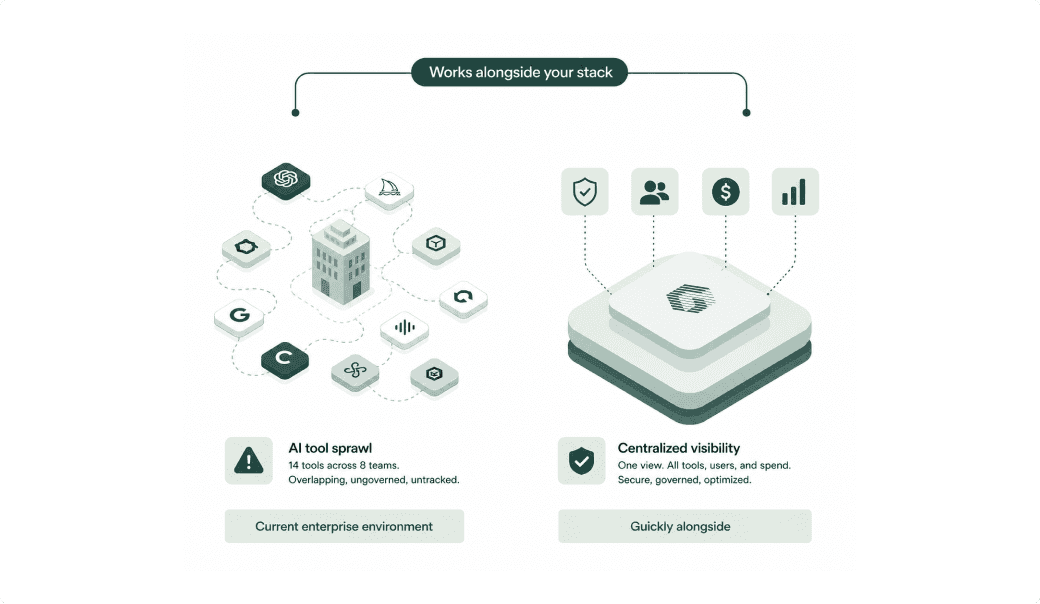
None of these decisions is wrong in isolation. The problem is what happens at scale. Six months later you have fourteen AI subscriptions across eight teams, three overlapping in function, two with lapsed security reviews, and none mapped to a business outcome. That isn’t a hypothetical. Productiv’s enterprise analysis found the average enterprise runs 14 AI tools while IT is aware of only four or five. The freedom is real. So is the gap.
The real cost isn’t the subscriptions
Direct subscription cost is the smallest part of the problem. What compounds faster is the organizational overhead. Time lost onboarding a different tool in every team. No shared prompting standards, so the same work gets re-figured-out five times. Security reviews that never happen. Volume pricing left on the table because spend is scattered across a dozen contracts instead of one.
Then there’s the data problem, and it’s the one that turns a finance issue into a board issue. When every team uses a different provider with different default settings, you have no unified view of what’s being sent where. Harmonic Security found 73.8% of enterprise ChatGPT use runs on personal accounts, and 82.8% of sensitive data going into AI tools traveled through those shadow accounts. Customer data may be flowing through a provider whose terms nobody reviewed. A strategy doc may be prompting a model that logs inputs by default. The cost of that shows up later, all at once: IBM puts the premium on a shadow-AI-related breach at $670,000 above a normal one.
What does centralized visibility actually give you?
The goal isn’t to restrict AI. It’s to understand it. When you can see every tool, every user, and every dollar in one place, you can make real decisions instead of guesses. Consolidate the overlapping subscriptions. Negotiate one enterprise deal instead of twelve. Enforce a data policy that actually holds. Measure ROI by team and use case, not by vibe.
That visibility also changes the conversation at the leadership level. Instead of answering “are we using AI?” with a shrug, you answer with data. That’s the line between a company that uses AI and one that’s genuinely AI-first. Seeing the full footprint, sanctioned and shadow, in one place is the problem Guickly was built to solve.
The teams that get there first
The teams that reach AI-first fastest aren’t the ones that moved slowest on adoption. They’re the ones that built visibility early, before the sprawl got too expensive to untangle. Freedom got them moving. Visibility is what lets them keep the speed without paying for it twice.
FAQ
What is the hidden cost of AI freedom? The hidden cost of AI freedom is the overhead that builds up when teams adopt AI tools independently with no coordination: overlapping subscriptions, duplicated onboarding, missed volume pricing, ungoverned data flows, and security reviews that never happen. The subscription fees are the smallest part; the organizational and data costs compound faster.
What is AI tool sprawl? AI tool sprawl is the accumulation of unsanctioned, uncoordinated AI tools across an organization, each adopted by a team in isolation and none mapped to a shared standard, budget, or outcome. Productiv found the average enterprise runs 14 AI tools while IT is aware of only four or five.
Is AI tool sprawl a security risk? Yes. When every team uses a different provider with different defaults, sensitive data flows through tools nobody reviewed. Harmonic Security found 73.8% of enterprise ChatGPT use runs on personal accounts, and IBM found shadow-AI-related breaches cost $670,000 more on average than breaches without it.
How do you control AI tool sprawl without slowing teams down? Not by blocking tools, which pushes usage further into the shadows. By building visibility: a single view of every AI tool, user, and dollar. That lets leadership consolidate overlaps, negotiate enterprise pricing, and enforce data policy while teams keep using what works.
What does it mean to be an AI-first company? An AI-first company can answer “what are we getting from AI?” with data rather than a guess. It has visibility into adoption, spend, and outcomes across the organization, which is what separates companies genuinely transformed by AI from those simply paying for a lot of it.

" height="16.667px" id="PxKarjvpl" width="16.667px"/></svg>)