Category:
AI Economics
Published date:
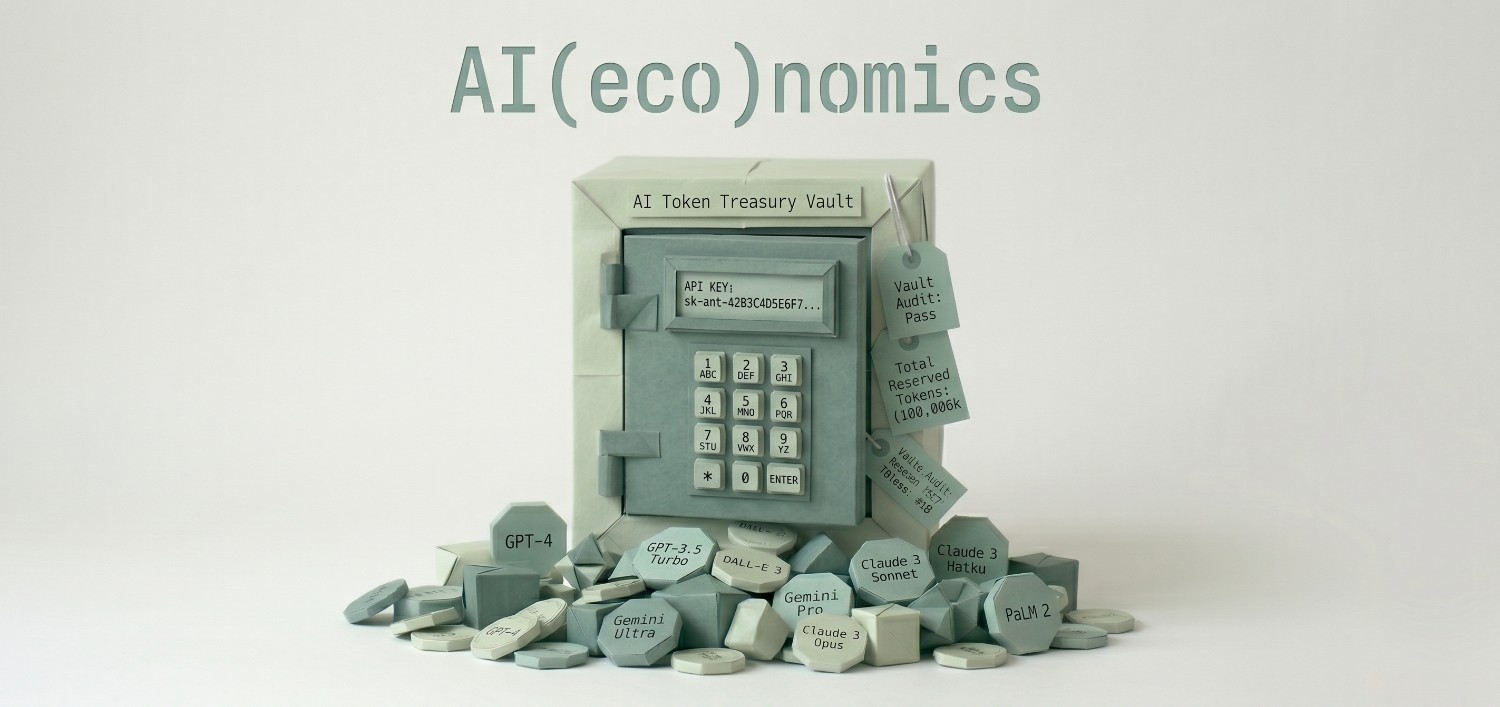
The AI Token Economy: Why Tokens Behave Like Currency
A token is the smallest unit of AI work, the way a cent is the smallest unit of a dollar. Tokens now pass the oldest test of money, substitution: they buy entertainment, productivity, advice and expertise that previously cost dollars or hours. The AI token economy is what emerges when tokens become the primary unit of both cost and value inside a company.
Key Takeaways
Tokens pass the substitution test that defines money. They now buy entertainment, productivity, advice, search, expertise and creative work that used to cost dollars or hours.
The industry already talks about tokens as a monetary unit. Nvidia describes "token factories" and measures "tokens per watt". OpenAI describes intelligence sold "on a meter, like electricity".
Some companies have begun allocating token budgets to employees on top of salary. That is compensation paid in a second currency.
Cost per token keeps falling while volume keeps climbing. That combination is exactly when an asset stops being a curiosity and becomes an economy.
A currency without a ledger is just leakage. Guickly is the ledger: every token of spend tied to what it produced.
Every AI conversation for the last three years has been about consumption. How many seats, how many calls, which model, how many tokens.
That is one side of an equation. The other side, the return, has gone almost entirely unmeasured. We have become extraordinarily good at spending tokens. We have barely started asking what each one buys.
Are AI tokens actually a currency?
Not legal tender. But they pass the oldest test of money, which is substitution. Can you exchange it for something with real utility?
Six places where tokens have already replaced dollars or hours:
Entertainment. An evening of aimless web surfing is now an evening of conversation with a model. Attention that went to feeds goes to prompts.
Productivity. Anyone can spin up a tool, a draft, an analysis on demand. Work that needed a hire or an agency now costs a few thousand tokens.
Interaction. Advice that came from a consultant, a tutor or a colleague now comes from a chat window.
Search. The question that went to ten blue links now goes to one answer. Even Google's own surface is shifting from serving links to spending tokens.
Expertise. The second opinion, the legal read, the research hours. Knowledge that carried an hourly rate now comes by the prompt.
Creativity. Design, copy, music and video that needed a studio or a freelancer now render from a sentence.
Utility is subjective, and the substitution is uneven. But the direction is not ambiguous.
Why does the industry talk about tokens like money?
Because the people selling them already do.
Nvidia describes AI infrastructure as a "token factory" and measures efficiency in tokens per watt, which is the language of a utility, not a software licence. Jensen Huang has said he was deeply alarmed that a $500,000 engineer did not consume $250,000 of tokens a year, which treats token consumption as a component of compensation.
Sam Altman describes intelligence sold "on a meter, like electricity", with cost per token falling roughly tenfold a year. Satya Nadella has pointed at Jevons paradox: when a resource gets cheaper, total consumption rises rather than falls.
Falling unit price with rising total volume is the signature of a commodity becoming an economy.
What is the AI token economy?
The AI token economy is the emerging system in which tokens become the primary unit of both cost and value inside an organisation. Spend is measured in tokens. Return is increasingly measured per token rather than per project.
The most striking version of this is already happening in compensation. Some companies have begun allocating token budgets to employees on top of salary, which is to say paying people partly in a second currency.
What does keeping the books actually require?
The same thing any currency required before it was trusted: a ledger.
Four things, and none of them is a usage total:
A complete inventory. Every tool and model in use, sanctioned and shadow. You cannot keep books on transactions you cannot see.
Attribution to a unit of work. Tokens per ticket resolved, per deal closed, per engineer-hour saved. The unit moves from tokens consumed to value produced per token.
A baseline. What the same outcome cost before AI. Without it you have a number with nothing to compare it against.
Marginal analysis. Whether the next token still pays. Return is a curve, not a figure, and the useful question is where it flattens.
Most enterprises run a token economy with no accounting. They can tell you roughly how much they spent. Almost none can tell you what a token earned.
A currency without a ledger is just leakage, and right now most AI budgets are leaking in the dark. The mechanics of building that ledger are in how to measure AI ROI, and the reason the bill keeps moving underneath you is in the AI pricing shift.
Every currency eventually gets its accounting
Gold got assayers. Dollars got ledgers. Tokens are next, because their price keeps falling while their volume keeps climbing, which is precisely when an asset stops being a curiosity and starts being an economy.
The companies that build the books first will write the rules of that economy. The rest will keep spending a currency they cannot count.
The question for your next board meeting is not how many tokens you burned last quarter. It is how much each one earned.
To start keeping the books, book a 15-minute walkthrough with the founder of Guickly.
FAQ
What does "AI tokens are the new currency" mean? It means tokens have started to function like money. They are metered, spent, and increasingly substituted for things people used to pay for in dollars or time, from entertainment to professional work. Some companies have begun allocating token budgets to employees on top of salary.
What is the AI token economy? The emerging system in which tokens, the smallest units of AI work, become the primary unit of both cost and value in an enterprise. Spend is measured in tokens, and return is increasingly measured per token rather than per project.
Why are AI tokens compared to money? Because they pass the oldest test of currency, substitution. Tokens now buy entertainment, productivity and advice that previously cost dollars or hours. Industry leaders reinforce the framing, describing token factories, intelligence sold on a meter like electricity, and engineer compensation measured partly in token budgets.
Are AI tokens actually replacing dollars? Not as legal tender, but as a unit of economic exchange inside organisations. As cost per token falls and usage compounds, tokens are becoming the largest variable cost in many enterprises and the truest measure of AI value.
How should companies measure AI token ROI? By shifting the unit from tokens consumed to value produced per token: tokens per support ticket resolved, per deal closed, or per engineer-hour saved. The goal is a ledger that ties every token of spend to a business outcome, not a monthly usage total.
What is a token factory? Token factory is Nvidia's framing for AI infrastructure, describing data centres as facilities that manufacture tokens the way a plant manufactures units. It comes with utility-style efficiency metrics such as tokens per watt, and it signals that tokens are being treated as a produced commodity rather than a software feature.
Why does the cost per token keep falling while bills keep rising? Jevons paradox. When a resource becomes cheaper, total consumption tends to rise rather than fall. Falling unit prices combined with compounding usage and thinner bundled allowances can produce a larger bill even as each token costs less.

" height="16.667px" id="PxKarjvpl" width="16.667px"/></svg>)